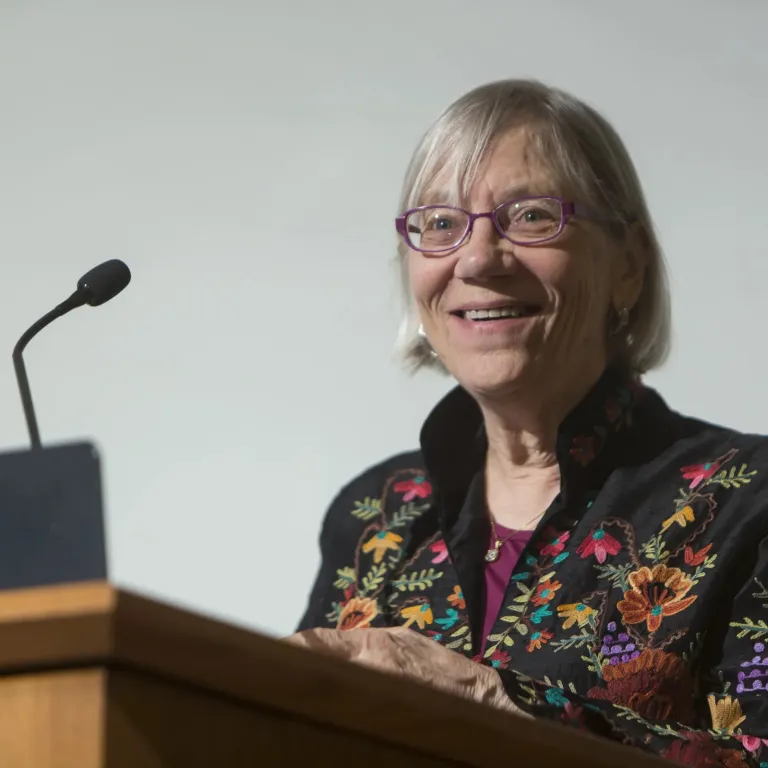
The Center for the Humanities has named acclaimed classicist, translator, and public intellectual Emily Wilson as the recipient of the International Humanities Prize, one of the university’s highest honors recognizing lifetime achievement in the humanities. Wilson will receive the prize and spend time on the WashU campus during Fall 2027, participating in a wide range of public events, classes, and community‑engaged programming.
Awarded biennially, the International Humanities Prize honors a scholar, writer, or artist whose body of work has had a profound impact on how we understand the human condition. Recipients deliver a public lecture and engage deeply with students, faculty, and community partners during their visit, reflecting the prize’s mission to connect rigorous humanities scholarship with broad public life.
A Transformative Voice in Translation and Public Humanities
Wilson is internationally recognized for her groundbreaking translations of Homer’s Iliad and Odyssey, works that have reshaped contemporary conversations about classical literature, translation, and accessibility. Her translations are widely praised for their formal precision, literary vitality, and ethical clarity—most notably her decision to translate the Homeric epics into iambic pentameter and to confront, rather than euphemize, themes such as slavery and gendered violence.
Beyond Homer, Wilson has translated plays by Euripides and Seneca, authored influential scholarly books on ancient philosophy and literature, and served as editor for several major reference works, including the Norton Anthology of World Literature and critical editions of the Odyssey and Oedipus Tyrannos. Her scholarship and public writing exemplify how humanities research can speak powerfully to contemporary audiences.
Equally significant is Wilson’s role as a public intellectual. Through essays, interviews, lectures, online reading projects, and social media, she has developed innovative ways of making classical texts accessible to global audiences. Her daily online readings of the Odyssey during the COVID‑19 pandemic and her extensive public commentary on translation have reached readers far beyond the university, modeling new possibilities for public‑facing humanities work.
A Broadly Collaborative Nomination and Visit
Wilson’s nomination was jointly submitted by the Departments of Classics; Comparative Literature and Thought; English; and Performing Arts, reflecting the wide reach of her work across disciplines.
The visit is further supported by campus partners including the College Writing Program, Institute for School Partnership, Department of Women, Gender, and Sexuality Studies, and the Office of Public Scholarship, along with community organizations such as the Classical Club of St. Louis, Saint Louis Chamber Chorus, Upstream Theater, and the University City Public Library.
During her time on campus, Wilson will engage with students and faculty across multiple departments, participate in public conversations and performances, and collaborate with community partners throughout the St. Louis region. Planned programming highlights the intersections of translation, literature, music, performance, and education, underscoring the humanities’ capacity to connect university scholarship with civic and cultural life.
Looking Ahead to Fall 2027
Wilson’s receipt of the International Humanities Prize marks a significant moment for WashU and its partners, celebrating scholarship that is at once rigorously academic and vividly public. Her visit in Fall 2027 will offer students, faculty, and community members a rare opportunity to engage directly with one of the most influential humanists of our time.